
The Best Kitchen Scale in Australia
Find the best kitchen scale for everyday cooking, baking and coffee, ranked on independent recommendations, maker specifications and price, with Amazon Australia stock checked.
On this page
- The best kitchen scales in Australia
- 1. Best overall: OXO Good Grips
- 2. Best for everyday weighing: Escali Primo
- 3. Best for small ingredient quantities: KitchenAid Dual Platform
- 4. Best for baker’s percentages: My Weigh KD-8000
- 5. Best budget kitchen scale: Etekcity EK6015
- 6. Best for heavy containers: Soehnle Page Profi
- 7. Best for coffee and baking: Fellow Tally Pro Studio Edition
- How we chose
- Kitchen scale buying guide
- Kitchen scale FAQs
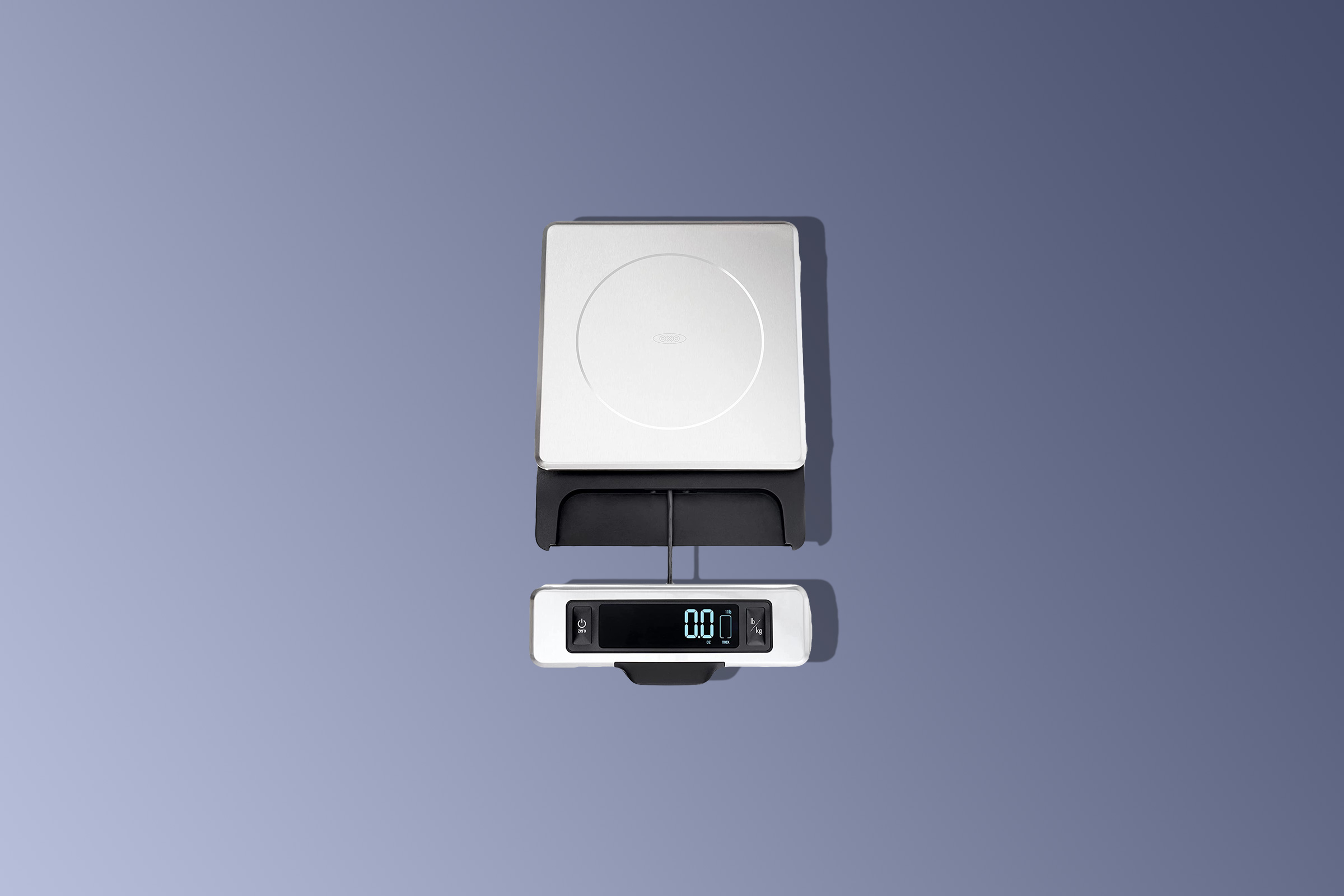
A mixing bowl covering the display makes weighing ingredients more fiddly than it should be. If you’re looking for the best kitchen scale, we’d buy the OXO Good Grips for its pull-out display and independent recommendations; choose the cheaper Etekcity EK6015 if keeping the cost down matters more.
The best kitchen scales in Australia
- Best overall: OXO Good Grips
- Best for everyday weighing: Escali Primo
- Best for small ingredient quantities: KitchenAid Dual Platform
- Best for baker’s percentages: My Weigh KD-8000
- Best budget kitchen scale: Etekcity EK6015
- Best for heavy containers: Soehnle Page Profi
- Best for coffee and baking: Fellow Tally Pro Studio Edition
| Product | Price | ||
|---|---|---|---|
 | OXO Good Grips 11 lb Stainless Steel Food Scale with Pull-Out Display (11214800) | from $70.85 | $70.85 at Amazon |
 | Escali Primo Digital Food Scale (P115) | from $57.97 | $57.97 at Amazon |
 | KitchenAid Dual Platform Digital Kitchen and Food Scale (KQ909WH) | from $88.45 | $88.45 at Amazon |
 | My Weigh KD-8000 (COMINHKPR107484) | from $156.47 | $156.47 at Amazon |
 | Etekcity EK6015 Digital Kitchen Scale | from $25.22 | $25.22 at Amazon |
 | Soehnle Digital Kitchen Scale Page Profi 100 (61507) | from $68.68 | $68.68 at Amazon |
 | Fellow Tally Pro Precision Scale | Studio Edition | from $379.00 | $379.00 at Amazon |
1. Best overall: OXO Good Grips
When your mixing bowl hides the numbers, you need a display you can move. The OXO Good Grips answers that problem with a pull-out display, which is the main reason we’d choose it for everyday cooking and baking.
Good Housekeeping recommends it as best overall for accuracy. That gives us a firmer reason to put it first than appearance or a long feature list.
Our take is that the removable platform is worth paying for if flour and sticky ingredients regularly end up around your bowl. Being able to remove the weighing surface should make cleaning less awkward.
The catch is price. It costs more than the Escali and substantially more than the Etekcity. If you use a small container that leaves the screen visible, the pull-out display may not justify the extra spend.
Pros
- Movable display helps keep readings visible beneath large bowls
- Removable platform makes cleaning more convenient
Cons
- Costs more than the Escali and Etekcity
Our verdict: Buy the OXO if a covered display is your everyday annoyance. It’s our first choice for a practical kitchen scale without paying for specialist coffee or baking functions.
2. Best for everyday weighing: Escali Primo
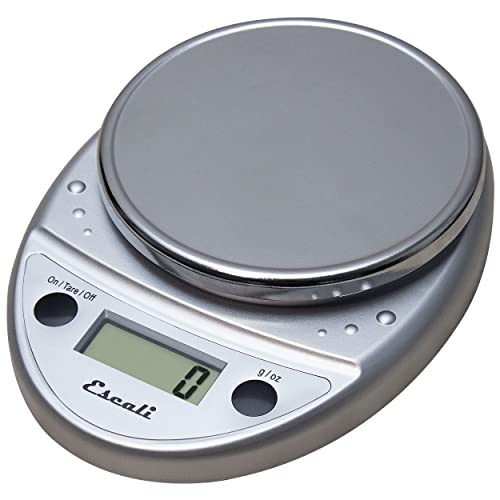
You may just want to weigh ingredients without spending extra on specialist functions. The Escali Primo earns its place through its recommendation for everyday weighing and a lower price than the OXO.
Our take is that the independent recommendation makes the Escali worth considering if you want a straightforward choice. But we wouldn’t call it the budget winner: the Etekcity costs less than half as much.
The supplied maker information is sparse. Before buying, confirm the controls, measurement increments and cleaning instructions on the listing rather than assuming it has features described for another scale.
Pros
- Less expensive than our overall pick
- Listed capacity accommodates up to 5 kg
Cons
- More than twice the price of the Etekcity
- Limited supplied specifications mean more checking before purchase
Our verdict: Choose the Escali if you value its recommendation for everyday weighing and don’t need specialist functions. We’d choose the Etekcity instead if price is the deciding factor.
3. Best for small ingredient quantities: KitchenAid Dual Platform
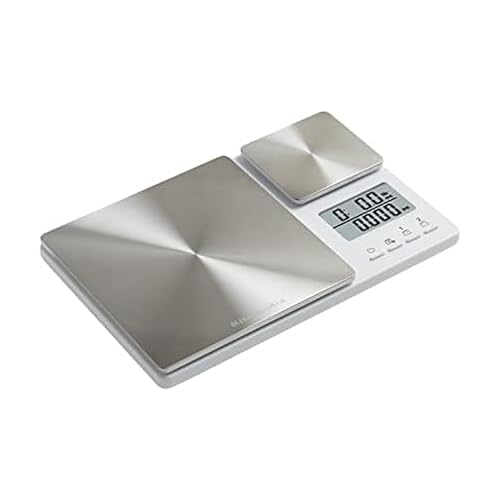
Weighing a bowl of flour and measuring a tiny addition are different jobs. The KitchenAid Dual Platform gives you separate platforms for them, making it our choice when small quantities matter as much as the main ingredients.
KitchenAid specifies 1 g increments on the main platform and 0.01 g increments on the smaller one. That finer readout is the reason to spend more here, though display increments alone don’t establish accuracy.
Tom’s Guide recommends it as best overall for combining everyday weighing with a separate precision platform for small ingredient quantities.
You do need to respect the smaller platform’s 500 g limit. And KitchenAid says to wipe the scale with a damp cloth and dry it thoroughly, rather than immersing it or putting it in the dishwasher.
Pros
- Separate precision platform provides finer increments for small additions
- Both weights appear together, reducing the need to switch between readings
Cons
- Precision platform is limited to 500 g
- Cannot be immersed or cleaned in the dishwasher
Our verdict: Buy this if you regularly weigh small additions alongside larger ingredients. For routine portions and basic recipes, we’d save money with the Etekcity.
4. Best for baker’s percentages: My Weigh KD-8000
Scaling a dough recipe means keeping ingredient proportions consistent as the batch changes. The My Weigh KD-8000 is the one we’d choose for that job because it includes percentage weighing.
Finder recommends it for baking, particularly its baker’s percentage calculations and generous weighing platform.
My Weigh specifies an 8 kg capacity, giving you room for larger batches and their container. The percentage function is the stronger reason to buy it, though. If you’re comfortable weighing fixed quantities from a recipe, you may never need that extra capability.
It costs considerably more than the OXO, Escali and Etekcity. Our take is that keen bakers can justify it; occasional cake makers probably can’t.
Pros
- Percentage weighing helps with proportion-based baking recipes
- 8 kg capacity allows for larger batches and containers
Cons
- Substantial price increase over the everyday picks
- Percentage weighing adds little value if you don’t use baker’s percentages
Our verdict: Choose the KD-8000 when you regularly scale dough recipes by percentage. Skip the extra expense if you mostly follow recipes with fixed ingredient weights.
5. Best budget kitchen scale: Etekcity EK6015
If you’re weighing lunch portions or ingredients for an occasional bake, keeping the purchase cheap makes sense. The Etekcity EK6015 is the cheapest pick here, with the controls we’d want for those jobs.
Etekcity specifies a 5 kg capacity and a tare function, so you can subtract the container’s weight before adding food. Finder recommends it as its best digital kitchen scale for convenient tare control and a platform that accommodates longer ingredients.
Where it falls short is tiny quantities. Etekcity recommends a minimum weight of 3–5 g, so we’d avoid it for additions below that range. Choose the KitchenAid if small quantities are a regular part of your recipes.
Pros
- Lowest checked price in this guide
- Tare control lets you weigh food directly into a container
- Backlit readout helps when the kitchen lighting is poor
Cons
- Recommended minimum of 3–5 g limits its usefulness for tiny additions
Our verdict: This is our value buy for everyday food weighing. Spend more only if you need finer increments, percentage weighing or help reading beneath a large bowl.
6. Best for heavy containers: Soehnle Page Profi
A heavy saucepan or a large batch can use up a scale’s capacity before you’ve finished adding ingredients. The Soehnle Page Profi is worth considering for that problem, with a listed 20 kg limit.
Soehnle says the hold function keeps the reading visible for ten seconds after weighing. That should help when a large container blocks the screen: remove it, then read the weight.
Finder recommends the Page Profi as its best overall Australian pick for large capacity, simple operation and a slim design for storage.
There’s a model detail to resolve before you order. The supplied product name identifies the Page Profi 100, model 61507, while the Amazon title says Page Profi 300. Confirm the exact model and listed functions rather than treating those names as interchangeable. That mismatch keeps it below our simpler recommendations.
Pros
- Listed 20 kg capacity suits heavy containers and bulk preparation
- Hold function lets you read the result after removing an obstructing container
Cons
- Conflicting model names need confirmation before purchase
Our verdict: Consider the Soehnle for heavy containers, but buy only after confirming which Page Profi model you’ll receive. For ordinary ingredient weighing, we’d choose a pick with clearer model information.
7. Best for coffee and baking: Fellow Tally Pro Studio Edition
If you weigh coffee and water for pour-over as well as ingredients for baking, a scale with ratio guidance can make sense. The Fellow Tally Pro is our specialist choice for that combination.
Bon Appétit recommends it for buyers wanting one precise scale for both home baking and coffee brewing.
Our take is that Brew Assist is the feature you’re paying for. Fellow says you choose your preferred coffee-to-water ratio and the mode guides you towards that target. If you don’t make pour-over coffee, there’s little reason to spend this much.
It’s the most expensive pick in this guide, and its listed 2.5 kg capacity requires more care with heavier bowls and batches. We’d choose the KitchenAid for small ingredient quantities unless coffee-ratio guidance is part of your daily routine.
Pros
- Ratio guidance supports pour-over preparation
- Removable weighing pan makes cleaning more convenient
Cons
- Highest checked price in this guide
- Listed 2.5 kg limit restricts heavier bowls and batches
Our verdict: Buy the Tally Pro if you’ll regularly use its coffee-ratio guidance as well as its weighing functions. For general cooking, we’d put the money towards something else.
How we chose
Our reviews draw on owner ratings where available, maker specifications, independent recommendations, and price and stock checks. We found no independent owner rating at the retailers we check for any of these seven picks, so we ranked them by their independent recommendations, practical features and price, favouring useful everyday choices before specialist purchases. All seven were in stock at Amazon Australia when checked, which is the only retailer shown stocking them in our supplied data; check the warranty and returns terms for your chosen offer before ordering.
Kitchen scale buying guide
If a bowl hides the display
Look for a way to read the result without changing your setup. The OXO’s pull-out display addresses this directly; the Soehnle’s hold function offers a different approach by keeping the result visible after you remove the container.
If you weigh tiny additions
Check measurement increments and the recommended minimum weight separately. A display showing 1 g increments doesn’t establish how reliably a scale measures a very small addition.
The KitchenAid specifies 0.01 g increments on its smaller platform. Etekcity recommends a minimum weight of 3–5 g. Choose around the quantities your recipes actually require.
If you cook large batches
Allow for the container as well as the ingredients when checking maximum capacity. Taring removes the container’s weight from the displayed reading; it doesn’t make the physical load disappear.
My Weigh lists an 8 kg limit, while the Soehnle listing specifies 20 kg. Confirm the Soehnle model before relying on that specification.
If you want less washing-up
A tare function lets you weigh successive ingredients into one container. Add an ingredient, zero the display, then add the next.
For cleaning the scale itself, a removable platform or pan is useful. Follow the maker’s care instructions: stainless steel doesn’t, by itself, establish that a whole scale is waterproof or dishwasher-safe.
If a recipe gives liquid volumes
Check which liquids the volume mode supports. The Etekcity lists water and milk modes; don’t assume those settings provide the right conversion for every liquid.
When a recipe gives a liquid quantity in grams, you can weigh it by mass without needing a millilitre mode.
If you’re trying to avoid overspending
The best food scales for you depend on the job you repeat most often. Ordinary ingredient weighing, tiny additions, large batches and pour-over ratios justify different purchases.
For basic portions and recipes, we’d start with the Etekcity. Pay extra when a specific feature solves a problem you already have.
Kitchen scale FAQs
What’s the best kitchen weighing scale for everyday cooking?
We’d choose the OXO Good Grips when large bowls make the display awkward to read. If you mainly use smaller containers and want to spend less, the Etekcity EK6015 is our budget recommendation.
What’s the best kitchen measuring scale for baking?
Choose the My Weigh KD-8000 if you work with baker’s percentages. The KitchenAid Dual Platform makes more sense when your priority is small ingredient quantities alongside larger amounts.
Are finer increments the same as better accuracy?
No. Increments describe the steps shown on the display. Accuracy describes how closely a reading matches the actual weight. Treat a maker’s precision claim as a claim, and don’t assume extra decimal places guarantee a better result.
Do you need a coffee scale for kitchen use?
You need to value its coffee functions enough to pay for them. The Fellow Tally Pro’s ratio guidance is relevant to pour-over preparation, but we’d choose a less expensive scale for routine food weighing.
You may also be interested in: