The Best Espresso Machines in Australia
The best espresso machines in Australia, from hands-on manual to fully automatic, compared on price at Australian retailers.
On this page
- The best espresso machines in Australia
- 1. Best overall: Breville the Oracle
- 2. Best fully automatic: De’Longhi PrimaDonna Soul
- 3. Best for hands-on home baristas: Breville the Barista Pro
- 4. Best mid-range fully automatic: De’Longhi Rivelia
- 5. Best budget espresso machine: Ninja Luxe Café
- 6. Best for iced coffee: Philips 5500 LatteGo
- 7. Best budget fully automatic: Philips 4400 LatteGo
- 8. Best if you’re set on Jura: Jura C8
- How we chose
- Espresso machine buying guide
- Frequently asked questions
Two café coffees a day add up quickly, and after a while you start wondering whether a machine on your own bench would pay for itself. Then you look at the shelf, and it’s full of bar ratings, boiler types and “barista” in every product name. If you want café-quality coffee at home with as little guesswork as possible, the best espresso machine in Australia right now is the Breville the Oracle. It grinds, doses and tamps for you and textures the milk by itself. Its owner score also comes from far more people than any other machine here.
It’s a big spend, though. The Breville Barista Pro costs less than half as much, and you’ll learn the milk side yourself. If you just want to press a button and walk away, the Philips 4400 LatteGo is the cheapest fully automatic machine on this list.
The short answer
The best espresso machines in Australia
- Best overall: Breville the Oracle
- Best fully automatic: De’Longhi PrimaDonna Soul
- Best for hands-on home baristas: Breville the Barista Pro
- Best mid-range fully automatic: De’Longhi Rivelia
- Best budget espresso machine: Ninja Luxe Café
- Best for iced coffee: Philips 5500 LatteGo
- Best budget fully automatic: Philips 4400 LatteGo
- Best if you’re set on Jura: Jura C8
| Product | Price | ||
|---|---|---|---|
 | Breville the Oracle Manual Espresso Machine (BES980BTR2JAN1) | from $2,198.00 at Amazon · 2 shops | $2,198.00 at Amazon |
 | DeLonghi Primadonna Soul Automatic Coffee Machine (ECAM61075MB) | from $1,588.00 at Amazon · 2 shops | $1,588.00 at Amazon |
 | Breville The Barista Pro Espresso Machine Black Truffle (BES878BTR4JAN1) | from $948.00 at Amazon · 2 shops | $948.00 at Amazon |
| Delonghi De'Longhi Rivelia Fully Automatic Coffee Machine | from $1,144.00 at JB Hi-Fi · 2 shops | $1,144.00 at JB Hi-Fi | |
 | Ninja Luxe Cafe Manual Espresso Coffee Machine (ES601ANZ) | from $731.00 at Amazon · 2 shops | $731.00 at Amazon |
 | Philips 5500 Series LatteGo Fully Automatic Espresso Machine (EP5541/20) | from $994.00 at Amazon · 2 shops | $994.00 at Amazon |
 | Philips 4400 Series LatteGo Fully Automatic Espresso Machine (EP4441/20) | from $798.00 at Amazon · 2 shops | $798.00 at Amazon |
| Jura C8 Fully Automatic Coffee Machine | from $1,899.00 at JB Hi-Fi | $1,899.00 at JB Hi-Fi | |
1. Best overall: Breville the Oracle
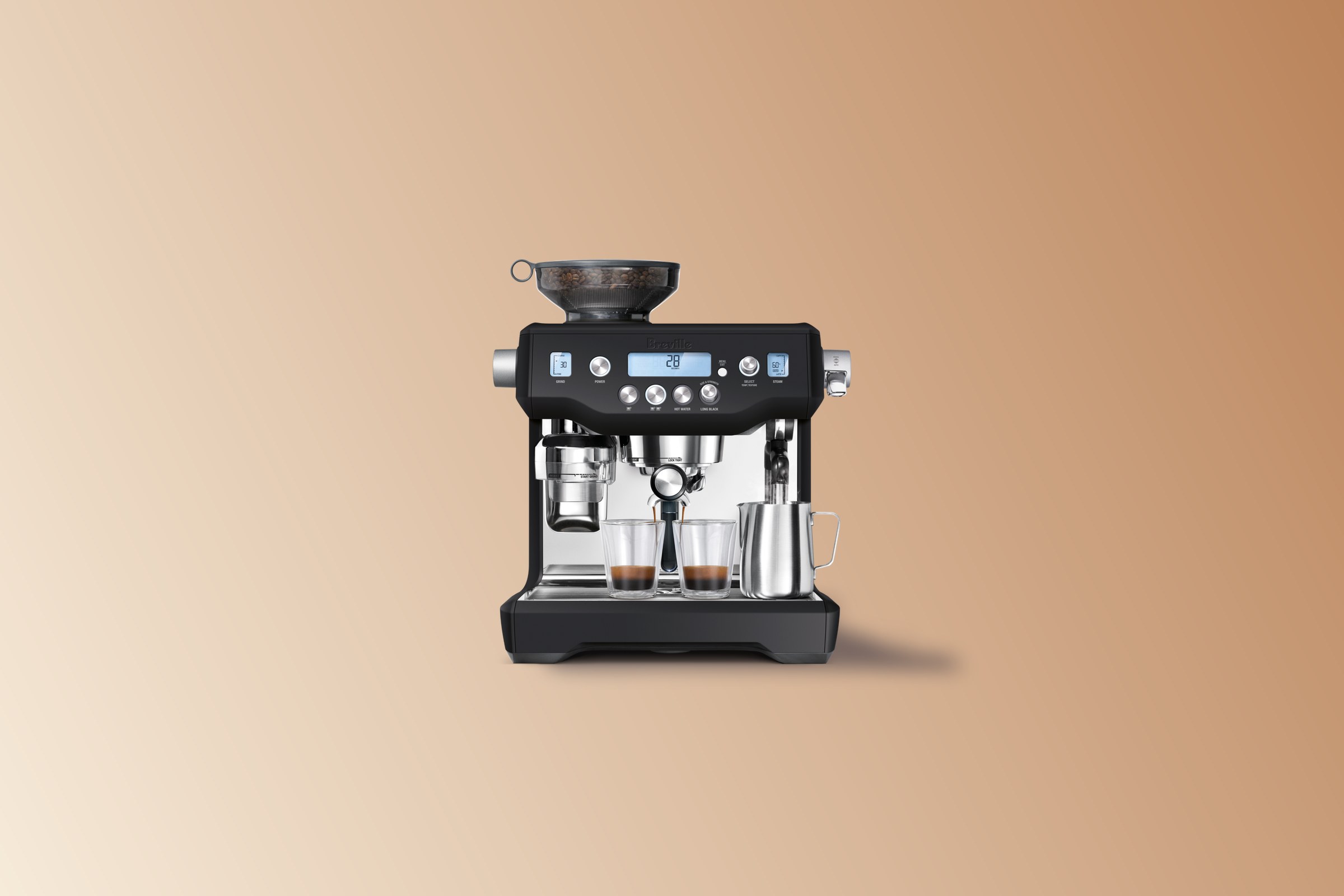
A real espresso machine usually means a learning curve. You have to get the grind right, the dose right and the tamp even, and then texture the milk without scalding it. Most people who give up on home espresso give up there. The Breville Oracle takes most of those steps off your hands while still making coffee the café way, with a portafilter.
Breville says the built-in grinder grinds, doses and tamps 22 g of coffee straight into the 58 mm portafilter. You lock it in and press a button. Day to day, that means no scales, no tamping mat and no coffee grounds across the bench. The steam wand works the same way: set the milk temperature and texture, and Breville says it produces microfoam on its own. If you’d like to try latte art later, you can switch to texturing by hand.
The dual boiler is the part that matters on a busy morning. Breville says it pulls the shot and steams the milk at the same time, so you’re not standing around waiting for one before you can start the other.
The catch is obvious. It’s the dearest machine in this guide by a clear margin. In return you get the strongest owner record here: 4.7 out of 5 from nearly 800 reviews at JB Hi-Fi. Nearly every machine on this page scores 4.7, so the score alone won’t separate them. The number of owners behind it does, and no other pick comes close.
Pros
- Grinding, dosing and tamping are done for you, so shots are consistent without practice
- Pours the shot and steams the milk at the same time
- Automatic milk texturing with a manual option for later
- Two-year repair warranty
Cons
- The most expensive machine in this guide
- More money than you need to spend if you mostly drink black coffee
Our verdict: If you drink milk coffee every day and want café results without learning to be a barista, this is the one to buy. If you’re happy to learn, the Barista Pro gets you most of the way for less than half the price.
- Amazon$2,198.00 LowestIn stock · as of 19 Oct, 5:17amBuy at Amazon
- JB Hi-Fi$2,199.00In stock · checked 18 OctView at JB Hi-Fi
Amazon price is accurate as of the time shown and can change. Other prices were checked on the retailer's site on the date shown.
2. Best fully automatic: De’Longhi PrimaDonna Soul
Some households don’t want to make coffee. They want a coffee to appear, and they want it to suit four different people. The De’Longhi PrimaDonna Soul is built for that. You pick a drink on the 4.3-inch touch screen and it does the rest, including the milk, from a 500 ml jug that De’Longhi says is double-walled to keep the milk cool for longer once it’s out of the fridge.
The clever bit is Bean Adapt. De’Longhi says you tell the app which beans you’re using and the machine sets its own grind, dose and temperature. That’s handy if you switch beans often and don’t want to start from scratch each time. The catch: it only works through the app, and plenty of people stop opening coffee machine apps after the first week. The 21 recipes and user profiles work from the screen, so you don’t lose much if you never set up Wi-Fi.
It scores 4.7 out of 5 from 257 owners at The Good Guys, which is a solid result. Prices vary between shops, so compare them below before you buy.
Pros
- Fully automatic milk drinks at one touch, with the milk kept in a cooler jug
- User profiles suit a household where everyone drinks something different
- Adjusts itself to new beans, according to De’Longhi
- Owner score backed by more than 250 reviews
Cons
- Bean Adapt needs the app and Wi-Fi to work
- A lot of money if one person drinks the same coffee every morning
Our verdict: It’s the pick for a busy household that wants push-button lattes and flat whites done properly. If it’s just you drinking the same coffee each day, the Philips machines further down do that for much less.
- Amazon$1,588.00 LowestIn stock · as of 19 Oct, 5:17amBuy at Amazon
- The Good Guys$1,899.00In stock · checked 18 OctView at The Good Guys
Amazon price is accurate as of the time shown and can change. Other prices were checked on the retailer's site on the date shown.
3. Best for hands-on home baristas: Breville the Barista Pro
Some people buy an espresso machine because they want coffee. Others want to make coffee, and to get properly good at the milk. For that second group, paying extra for automatic steaming means paying to skip the part you were looking forward to. The Breville Barista Pro gives you the grinder and the temperature control, then hands you a manual steam wand and lets you get on with it.
The ThermoJet heater is the feature you’ll notice first. Breville says it reaches extraction temperature in 3 seconds and switches straight from espresso to steam. In practice that means no waiting around for the machine to warm up before the school run. The built-in grinder doses on demand, so you don’t need a separate grinder taking up bench space.
It’s less than half the price of the Oracle and scores the same 4.7 out of 5, from 215 owners at The Good Guys. Where it falls short is the warranty: Breville lists 1 year, where the Oracle and the Ninja both come with 2. And you’ll pour a few flat, bubbly lattes before you get the hang of the wand.
Pros
- Ready to brew almost as soon as it’s on, according to Breville
- Built-in grinder saves buying a separate one
- Same owner score as the Oracle for less than half the price
- Comes with a milk jug and a dose trimming tool
Cons
- One-year warranty, shorter than the Oracle’s or the Ninja’s
- Texturing milk by hand takes practice before it looks or tastes right
Our verdict: This is the value buy for anyone who wants to learn proper espresso and latte art at home. If you’d rather never touch a steam wand, spend the extra on the Oracle or go fully automatic.
- Amazon$948.00 LowestIn stock · as of 19 Oct, 5:17amBuy at Amazon
- The Good Guys$949.00In stock · checked 18 OctView at The Good Guys
Amazon price is accurate as of the time shown and can change. Other prices were checked on the retailer's site on the date shown.
4. Best mid-range fully automatic: De’Longhi Rivelia
You like the idea of the PrimaDonna Soul but not the price. The De’Longhi Rivelia is De’Longhi’s fully automatic machine with a milk system, and it costs noticeably less than the PrimaDonna. Owners rate it 4.7 out of 5 from 111 reviews at JB Hi-Fi.
The retailer listing gives us very little beyond the basics, so we can’t tell you what recipes or settings it has. Read the full spec at the retailer before you buy. What we do know is its size: 24.5 cm wide but 38.5 cm tall, so measure the gap under your overhead cupboards.
Pros
- Fully automatic milk drinks for noticeably less than the PrimaDonna Soul
- Slim footprint on the bench
- Owner score from more than 100 reviews
Cons
- The retailer listing gives few details, so you’ll need to check the features yourself
- At 38.5 cm tall it may not fit under low overhead cupboards
Our verdict: A sensible middle choice if you want De’Longhi push-button coffee without paying PrimaDonna money. Check the full spec and your cupboard height before you order.
- JB Hi-Fi$1,144.00 LowestIn stock · checked 18 OctBuy at JB Hi-Fi
- The Good Guys$1,144.00 LowestIn stock · checked 18 OctView at The Good Guys
Prices were checked on each retailer's site on the date shown and can change.
5. Best budget espresso machine: Ninja Luxe Café
One person in your house wants a flat white and another wants a mug of filter coffee. Normally that’s two machines on the bench. The Ninja Luxe Café does espresso, filter coffee and cold brew from one unit, and it’s the cheapest machine in this guide.
Ninja has put in a few helpers that make it easier to learn than a fully manual machine. The built-in scale and assisted tamper take some of the guesswork out of the dose, and the frother has automatic presets, so you don’t have to judge the milk by ear. You still lock in a portafilter and tamp, so it’s more hands-on than the Philips or De’Longhi machines.
It scores 4.7 out of 5 from 102 owners at The Good Guys. Skip it if you only ever drink espresso-based coffee: the filter and cold brew settings are features you’re paying for and won’t use.
Pros
- The lowest price in this guide
- Espresso and filter coffee from one machine, so you need less space on the bench
- Scale and assisted tamper make getting started easier
- Automatic milk presets
Cons
- More hands-on than a fully automatic machine
- Filter and cold brew settings add cost if you only drink espresso
Our verdict: The best way into real espresso without spending Breville money, and the obvious choice if your household wants both espresso and filter coffee. If you want zero effort, the Philips 4400 costs a little more and does it all for you.
- Amazon$731.00 LowestIn stock · as of 19 Oct, 5:17amBuy at Amazon
- The Good Guys$799.00In stock · checked 18 OctView at The Good Guys
Amazon price is accurate as of the time shown and can change. Other prices were checked on the retailer's site on the date shown.
6. Best for iced coffee: Philips 5500 LatteGo
Plenty of people put up with a summer of melted-ice café coffee before they start looking at machines that make it at home. The Philips 5500 LatteGo has iced coffee and iced latte as presets, alongside 18 other hot and iced recipes, so you don’t have to work out the ratios yourself.
The LatteGo milk system is the bigger selling point for everyday use. It’s two parts with no tubes, and Philips says it rinses clean in under 10 seconds. Cleaning the milk lines is the job that makes people stop using automatic machines, so that matters more than the recipe count.
Its 4.9 out of 5 is the highest score here, but it comes from 18 owners at The Good Guys. That’s a promising start, not a verdict.
Pros
- Iced coffee presets, so there’s no guessing at ratios
- Milk system with no tubes that’s quick to clean
- Froths plant milk, according to Philips
- Quieter than older Philips machines, says Philips
Cons
- Its top score rests on fewer than 20 reviews
- Costs more than the 4400 mostly for extra recipes
Our verdict: Buy it if iced coffee is a regular thing at your place and you want a milk system that’s easy to clean. If 12 recipes will do, the 4400 below saves you money.
- Amazon$994.00 LowestIn stock · as of 19 Oct, 5:17amBuy at Amazon
- The Good Guys$999.00In stock · checked 18 OctView at The Good Guys
Amazon price is accurate as of the time shown and can change. Other prices were checked on the retailer's site on the date shown.
7. Best budget fully automatic: Philips 4400 LatteGo
Most people who buy a fully automatic machine end up making the same two or three drinks forever. If that sounds like you, the Philips 4400 LatteGo is the one to look at. It’s the cheapest fully automatic machine in this guide, it uses the same easy-clean LatteGo milk system as the 5500, and it still has 12 recipes, including iced ones.
The AquaClean filter is a nice extra. Philips says it filters the water and lets you make up to 5000 cups without descaling. That “up to” is doing some work, but the point stands: less maintenance.
The rating is 4.7 out of 5 from only 15 owners at The Good Guys, so you’re taking more of a punt than with the Breville or De’Longhi machines.
Pros
- The lowest-priced fully automatic machine here
- Easy-clean milk system with no tubes
- Water filter means less descaling, according to Philips
Cons
- Only 15 owner reviews so far
- 12 recipes, against 20 on the 5500
Our verdict: The best value if you want a button that makes a decent flat white. Skip it only if you want the larger recipe list or a longer owner track record.
- Amazon$798.00 LowestIn stock · as of 19 Oct, 5:17amBuy at Amazon
- The Good Guys$899.00In stock · checked 18 OctView at The Good Guys
Amazon price is accurate as of the time shown and can change. Other prices were checked on the retailer's site on the date shown.
8. Best if you’re set on Jura: Jura C8
If you’ve already decided on Jura, the Jura C8 is the model on sale here. It’s fully automatic with Thermoblock heating, and at 32.5 cm tall it’s the lower of the two machines here with a listed height, so it’s more likely to fit under overhead cupboards. Owners give it 4.7 out of 5, but that’s from 10 reviews at JB Hi-Fi.
That’s where our enthusiasm stops. The retailer listing gives very little detail on drinks or milk handling, and it’s the second-dearest machine here. The PrimaDonna Soul has many more owner reviews behind it. Read the warranty and returns terms before you buy.
Pros
- Lower height fits under more overhead cupboards
- Fully automatic, with no grinding or tamping to do
Cons
- Owner score from only 10 reviews
- Costs more than the PrimaDonna Soul at Amazon, with much less detail on what you get
Our verdict: Only for buyers who already want a Jura. Everyone else gets a better-supported fully automatic machine for less with the De’Longhi PrimaDonna Soul.
- JB Hi-Fi$1,899.00In stock · checked 18 OctBuy at JB Hi-Fi
Prices were checked on each retailer's site on the date shown and can change.
How we chose
These picks are based on owner ratings, maker specifications and price and stock checks. We looked at espresso machines on sale at Amazon Australia, JB Hi-Fi and The Good Guys and ranked them on retailer review scores, weighted by how many reviews each score comes from. Features come from the manufacturers’ and retailers’ listings. Prices and stock are checked automatically, and the date of the last check is shown on each product box.
Espresso machine buying guide
Most people buy more espresso machine than they need. Start with how you actually drink coffee, and the right type usually becomes obvious.
If you want to press a button and walk away, buy a fully automatic machine. The De’Longhi, Philips and Jura models here make the whole drink at the touch of a button. You give up some control over the shot, but on a weekday morning that’s usually a fair swap.
If you want to learn the craft, look for a machine with a portafilter and a manual steam wand, like the Breville Barista Pro. It’s cheaper for what you get, and learning to texture milk is half the fun. If you want the café method without the learning curve, the Oracle automates the hard parts.
If you mostly drink black coffee, don’t pay for an elaborate milk system. An espresso or long black needs good grinding and steady temperature, not 20 milk recipes.
If you dread cleaning, look at the milk system first. A jug or carafe with no tubes, like Philips’s LatteGo, is the easiest kind to keep clean. Machines with a water filter also tend to need less descaling, which matters if you’re in a hard-water area.
If your mornings are rushed, heat-up time matters. Look for fast-heating systems or a dual boiler that pulls the shot and steams the milk at the same time.
If your bench is tight, measure the space, especially the height under your overhead cupboards. The two machines here with a listed weight, the Rivelia and the Jura C8, are both about 10 kg, so plan on leaving yours where it sits.
Don’t be swayed by bar numbers. Breville’s own listing for the Oracle says it extracts at 9 bar using a 15 bar pump, so a bigger pump figure on the box tells you very little on its own.
Check the warranty. Terms vary between brands, from one year to two among the machines in this guide. For an appliance you’ll use every day, that’s worth looking at before you pay.
Frequently asked questions
Is an espresso machine cheaper than buying coffee out?
If you buy coffee most days, a machine usually works out cheaper over time, even after you pay for beans, milk and the occasional descaler. If you only buy a coffee on weekends, it’s harder to justify the cost of a good machine.
Should I buy a manual or a fully automatic espresso machine?
Buy a manual machine if you enjoy the process and want control over each shot and the milk. Buy a fully automatic one if you want a consistent coffee with no effort, or if several people in the house use it. Machines like the Breville Oracle and the Ninja Luxe Café sit in between. You still use a portafilter, but the machine handles some of the steps for you.
Do I need a separate grinder?
Not with most of the machines here. The two Brevilles, the De’Longhi PrimaDonna Soul, the Ninja and the Philips 4400 list built-in grinders, which saves bench space and money.